


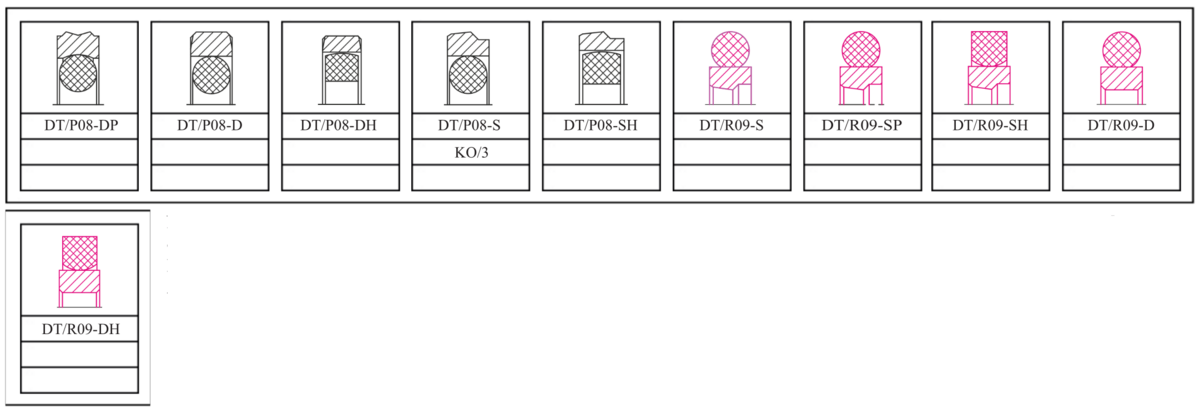
Sliding Seals: Reliability and Durability.
Advanced seals made of PTFE with elastic elements offer excellent friction resistance, making them ideal for dynamic, high-pressure applications.
The unfavorable behavior of O-rings, which causes friction and damage during dynamic operation, led to the development of sliding seals. Due to their excellent sliding properties, PTFE modified with carbon (graphite), bronze, or glass fibers is used to make these seals. Since PTFE is not as elastic as rubber materials, an elastic element, such as an O-ring or rectangular ring, is placed on the sliding ring to ensure proper sealing. This elastic element seals only static surfaces, preventing damage.
Most of these seals require minimal installation space and are suitable for snap-in installation. They are resistant to sudden loads and can handle high-pressure levels and linear speeds. Sliding seals are primarily manufactured as piston seals. In this case, the sliding ring has a smooth surface but can also be used for rod sealing. The surface of the sliding ring is designed to ensure a better grip. For improved sealing, two sliding seals are often installed.

- Sealing/sliding element (PTFE + graphite / glass fibers / bronze, PU)
- Elastic element (NBR, FPM - Viton)
-
 Datasheet 1 - DT (pdf) 567 KB
-
 Datasheet 2 - DT (pdf) 110 KB