

Seals for hydraulics and pneumatics


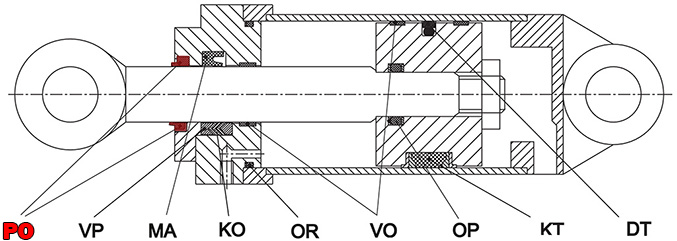
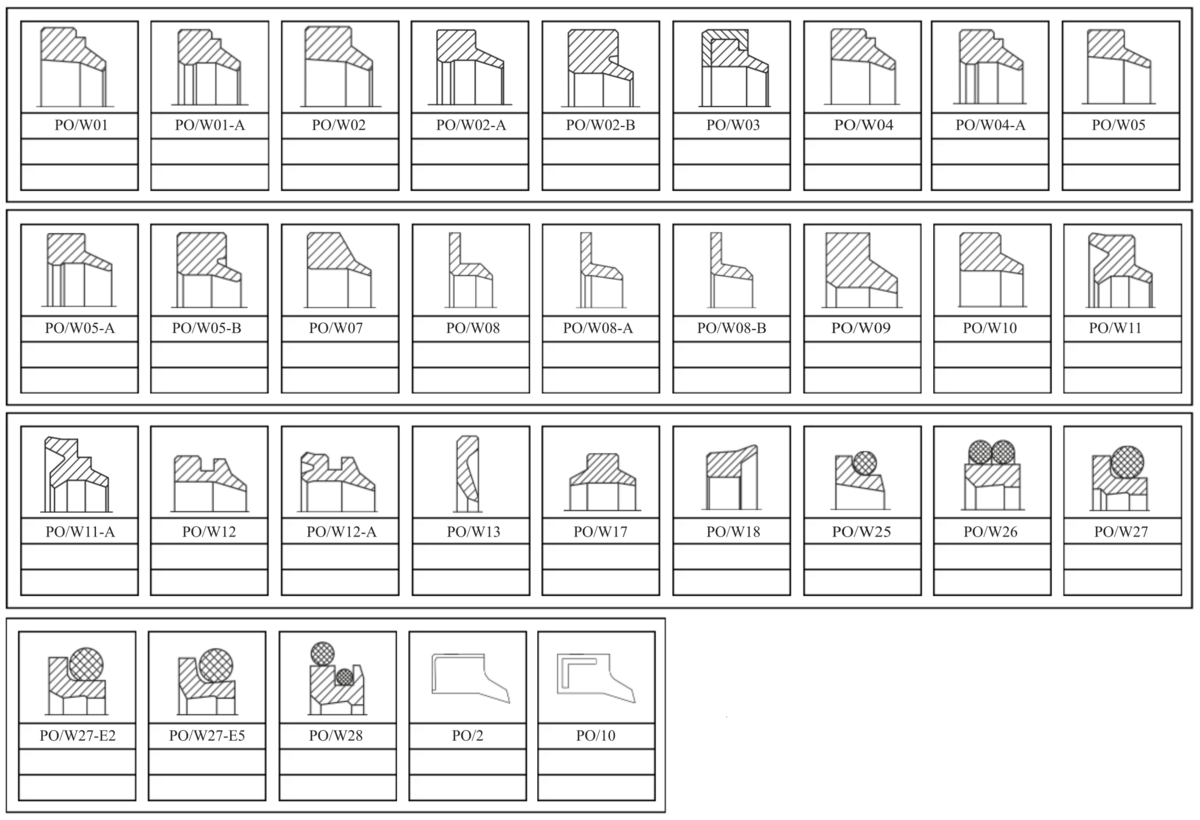
The role of scraper rings (wipers) is to prevent the entry of hard dirt particles into hydraulic and pneumatic systems, such as cylinders or valves. This avoids energy losses in the pressure medium, damage to seals, moving surfaces, and guiding shafts.
When working with folded bellows, which offer universal protection, it is important to keep in mind their sensitivity to damage. For this reason, their use is limited to specific situations. In most cases, the scraper ring provides sufficiently effective protection. The most practical solution is the production of a single-lip ring made from a particularly durable elastomer.
It is crucial to ensure that the scraper rings remain undamaged. The internal diameter of the installation space, for example on piston rods, must be precisely executed to ensure proper positioning and function of the ring.
Since scraper rings adhere to the piston rods under external preload, they can increase friction at the start of movement. Additionally, this preload, combined with the sharp edges of the wipers, may cause slight oil leakage along the piston rod during its operation. This leakage must be taken into account when designing and maintaining the system.

- NBR (80 – 90 ShA)
- PU
- FPM - Viton®
Manufacturers offer elastomeric sealing rings as elements with a metal coating.
It is also possible to obtain special products for specific needs, such as balancing larger radial deviations or for designs with an internal opposing lip.
Firmly installed designs should always be given priority.

-
 Datasheet 2 - PO (pdf) 545 KB

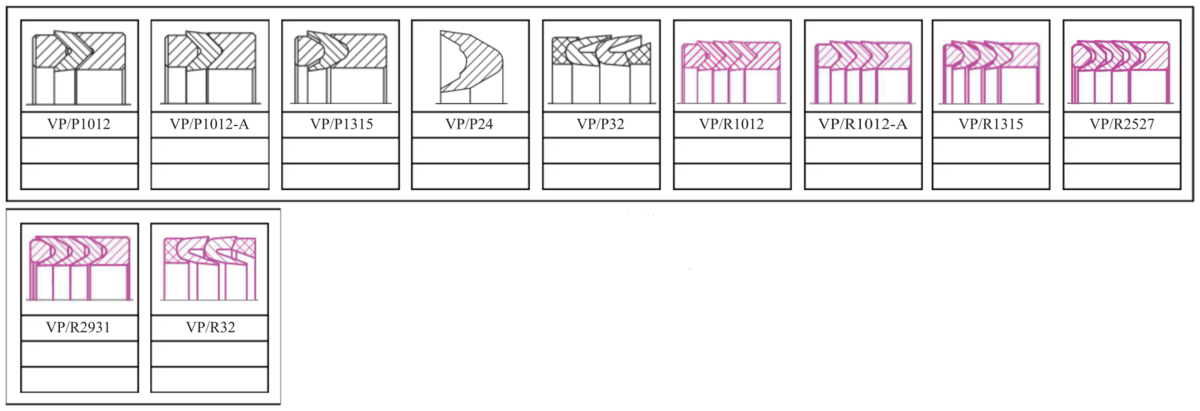
A Vee-Pack seal provides durable, reliable sealing for rods and pistons under variable loads and harsh conditions.
Vee-Pack sealing elements are made of NBR, PU-AU, and POM for heavy-duty applications.
Vee-Pack is most commonly made from sealing materials such as NBR, fabric-reinforced NBR, or PU-AU, while the pressure and support rings are made from POM. The sealing elements are arranged to interlock at their edges.
During axial loading or operation, pressure is evenly distributed on both sides and along the entire height of the seal.
This ensures an effective sealing performance, albeit with increased friction. This system is used for sealing rods and underwater pistons under demanding working conditions. It is recommended for applications where the load is difficult to predict.

-
 Datasheet 2 - VP (pdf) 994 KB
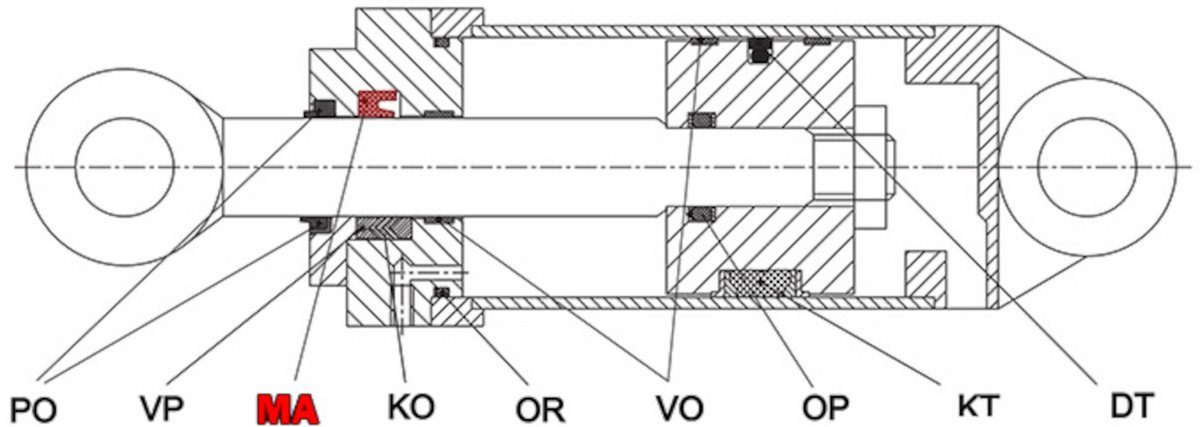
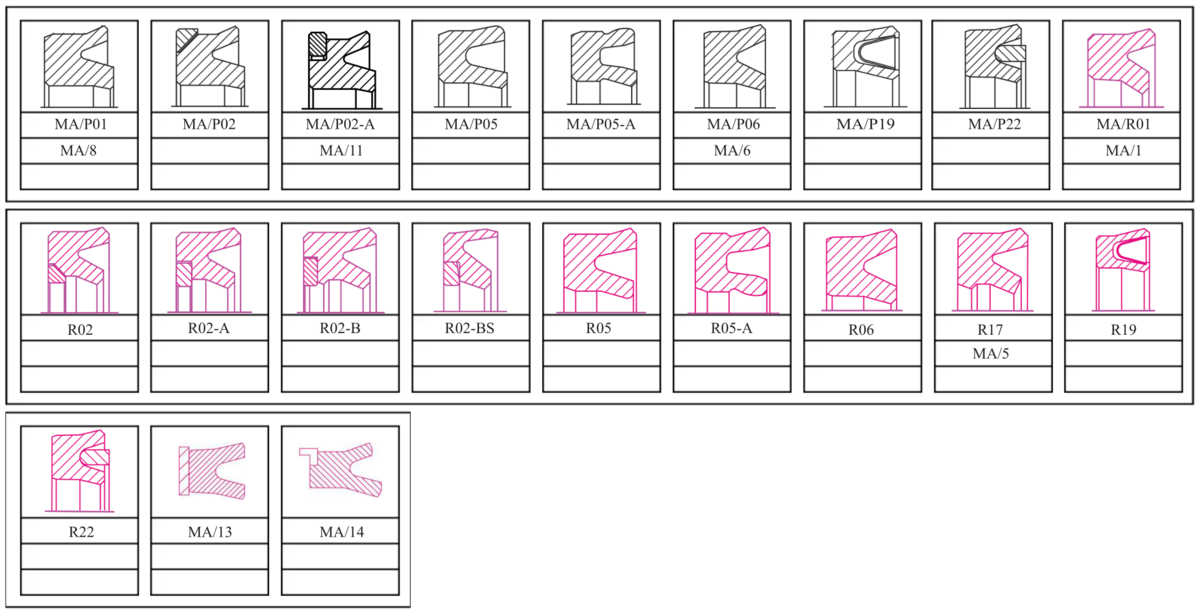
U-Cup seals are axial sealing elements designed for translational motion. Their development addresses the need for dynamic sealing elements that provide efficient sealing with minimal friction during operation. This reduces the risk of excessive seal damage and extends its service life.
The profile of a seal consists of a sealing lip (edge) and a sturdy base part positioned in the installation groove. The base ensures stable mounting, which is crucial for sealing on the static sealing surface. At the same time, the base supports the seal within the groove, often eliminating the need for additional support rings. The shape of the sealing lips and the base is tailored to the specific tasks of the seal during operation. Their design considers demanding sealing conditions, including the type of seal (internal or external), the pressure level of the medium, and the movement speed.
A seal is an independent sealing element with elastic edges, primarily intended for dynamic sealing of translational movements across a wide range of pressures from the pressure medium. It is available in various shapes and adaptable to diverse operating conditions, with a selection of numerous materials.

Sealing with a U-Cup seal is achieved by installing it in a groove approximately 10% wider than the seal itself. During installation, the sealing lips elastically deform, creating the necessary contact pressure (preload) between the seal edge and the surface. As the medium pressure increases, the pressure of the seal edge on the surface proportionally increases, ensuring effective sealing based on the principle of pressure and load.
At very high pressures, the cross-section of the seal expands radially, further increasing the contact area and sealing efficiency. However, this also increases friction, which can lead to damage or failure of the seal. Therefore, the correct selection of the seal is crucial to achieving an optimal balance between sealing, friction, and durability (shape, material).
By adding fabric to the rubber material of the seal, it becomes stronger and more durable under higher medium pressures. The fabric fibers create small "pockets" on the seal's surface, which trap lubricant during operation. This reduces friction and prevents damage, even under high pressures. Increasing the contact pressure between the seal and the sealing surface minimizes excessive friction and damage.
For specific needs, materials such as EPDM, VMQ, FPM, HNBR, and PTFE are used.
Advantages of U-Cup seals:
- Linear dependence between sealing effect and increase in medium pressure
- Excellent sealing across a wide pressure range
- Low coefficient of friction
- Simple groove design for installation
- Easy installation
- Wide variety of cross-section shapes and materials
- Broad range of applications (varied pressures, temperatures, and media)
Applications:
- Sealing pistons and rods in hydraulic and pneumatic cylinders
- Underwater plungers and fluid pumps
Instructions for Use:
Before installation, ensure the following:
- The specified grooves are properly machined on the cylinder, such as on the rod (with a rounding angle of 15–20°) to prevent mechanical damage to the seal during installation.
- All surfaces are free of sharp edges.
- The system is cleaned of foreign particles and contaminants.
- Seals and sealing elements must be oiled or greased before installation. It is recommended to use the medium intended for the system or a similar lubricant.
- Avoid lubricants containing solid particles or additives during installation.
- Use tools without sharp edges during installation to prevent damage.
Elastomers:
- PUR DIPUR-H
- NBR DIRUB-N
- HNBR
- FPM DIRUB-F
Thermoplastics:
- PTFE DIFLON-3 (40% bronze)
- PTFE DIFLON-1 (pure)
- PTFE DIFLON-2 (graphite)
- POM DITAL-1
-
 Datasheet 1 - MA (pdf) 492 KB


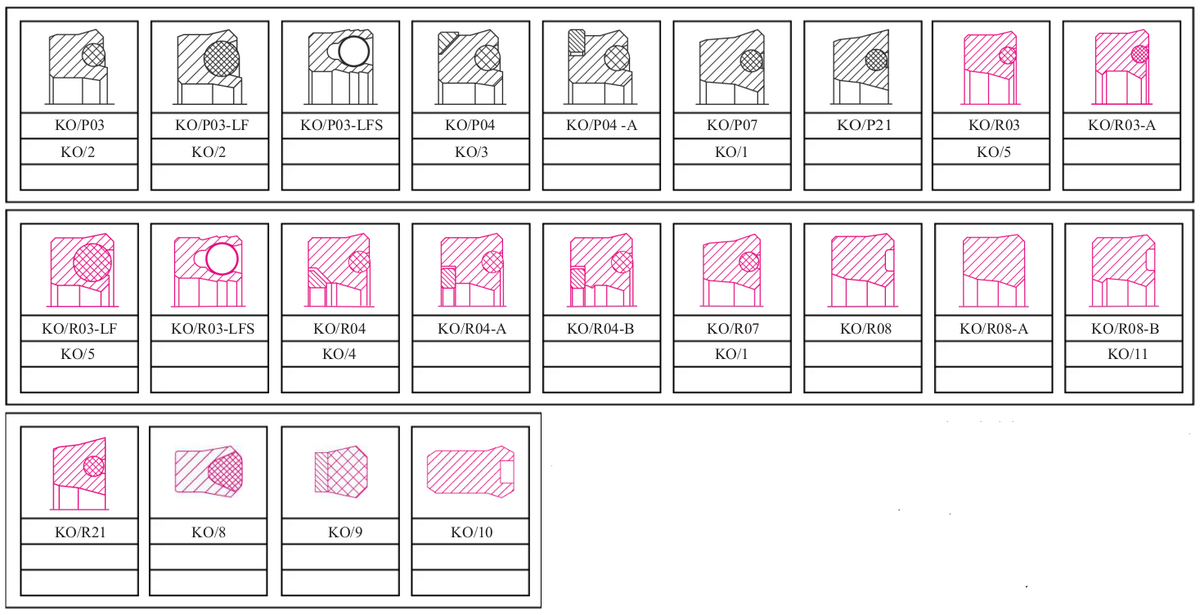
Compact seals seal rods and cylinders up to 400 bar, made of NBR or PU, often with a support ring for increased durability.
Compact seals are primarily made from fabric-reinforced NBR or polyurethane (PU). Various types of fabrics and rubbers are used. Seals made from a combination of soft, elastic materials and hard, wired materials can serve multiple purposes. Compact seals and their elastic components release oil at lower pressures and can withstand up to 250 bar of working pressure. These seals are manufactured as single-piece units or fabric-reinforced seals and are used for rods or unilaterally operating cylinders.
They can also be made from polyurethane (PU-AU) with an NBR support ring, allowing them to handle pressures up to 400 bar (examples include those with POM anti-extrusion rings).
Compact seals provide effective sealing even at lower pressures. When determining the installation groove, it is important to account for radial compression of the seals during installation, which increases their length. Adequate space in the groove must be ensured; otherwise, the required sealing pressure cannot be achieved.
Some compact seals come with support or anti-extrusion rings.
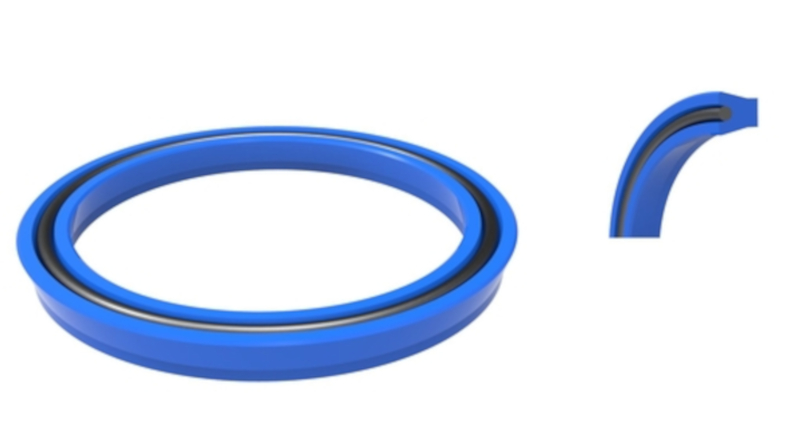
Advantages:
- Excellent static and dynamic sealing, even at lower pressures
- Compact seal combinations/versions with anti-extrusion/support rings are available
-
 Datasheet 1 - KO (pdf) 600 KB
-
 Datasheet 2 - KO (pdf) 562 KB



O-ring seals (OR) are the most well-known and versatile type of seals.
They are suitable for installation in both static (static sealing) and moving machine parts (dynamic sealing).
They are notable for their ease of installation and the wide range of materials available for various operating conditions.
With the advancement of automation, the use of O-rings has expanded into areas such as:
- Mechanical engineering
- Pneumatics
- Hydraulics
- Installations
By incorporating additional support rings, their application has extended to high-pressure media sealing. Support rings are typically made of PTFE (Teflon), which features a low coefficient of friction and excellent chemical and thermal stability.

Support rings prevent the seal from being pushed out of the groove into the space (gap) between the sealed surfaces, thereby extending the seal's lifespan. The use of support rings is justified in the following cases:
- At higher pressures
- At larger gaps between the sealed surfaces
- With higher relative speeds of the sealed surfaces
- At higher operating temperatures, e.g., temperature fluctuations
- In dirty systems
The area of O-ring seals is covered by various standards.
The German standard, DIN 3770, which aligns with the international standard ISO 3601, is the most common in our region (tolerance, quality criteria).
Use according to the type of sealing:
Static sealing
a.) O-rings are used as flanges, covers, and couplings in installation seals…
Dynamic sealing
a.) Sealing elements with translational motion (unilateral/bilateral sealing) in components belonging to hydraulic and pneumatic systems (cylinders, rods, distribution slides, etc.).
b.) Sealing elements with rotational motion (shafts, bearings, gears, etc.).
The advantages of using O-rings compared to other seals are:
- Easy installation
- Wide application (static, dynamic, unilateral, bilateral operation)
- Wide selection of sizes and materials
- Symmetrical cross-section that prevents incorrect installation
- Simple groove shapes (space and cost savings during production)
- Low cost
For proper O-ring selection, the following must be known:
- Pressure (hardness selection – shA / support rings?)
- Operating conditions, temperature, medium (material selection)
- Groove dimensions, i.e., piston and cylinder sizes (installation dimensions)
- Type of sealing (static / dynamic – translational, rotational)
When selecting an O-ring, sufficient tolerance for the inner diameter "d" should be considered with the correct thickness "s," which does not affect sealing quality:
- Up to 5% smaller "d" (external sealing)
- Up to 3% larger "d" (internal sealing)
Operating Conditions:
O-rings are self-contained sealing elements with dual functionality. The thread forces created during installation (pre-tension of the diameter) are further increased by the system's media pressure. This generates an overall pressure (contact with surfaces in all directions), which increases as the system pressure rises.
Marking of O-rings (DIHTA):
- O-rings are dimensionally marked with the inner diameter "d" and cross-sectional thickness "s" (e.g., OR 100 x 3 // d = 100 mm; s = 3 mm)
- OR _d x s _N xxx
- Material markings – type of elastomer
- Seal cross-sectional thickness (mm)
- Inner diameter of the seal (mm)
- Group markings
The selected material is crucial for the sealing ability, operational reliability, and lifespan of the seal.
The right material – one that is tailored to the operating conditions – and the shape of the seal are decisive for the flawless operation of the seal.
Temperature, pressure, and the type of medium are key factors in selecting the proper material.


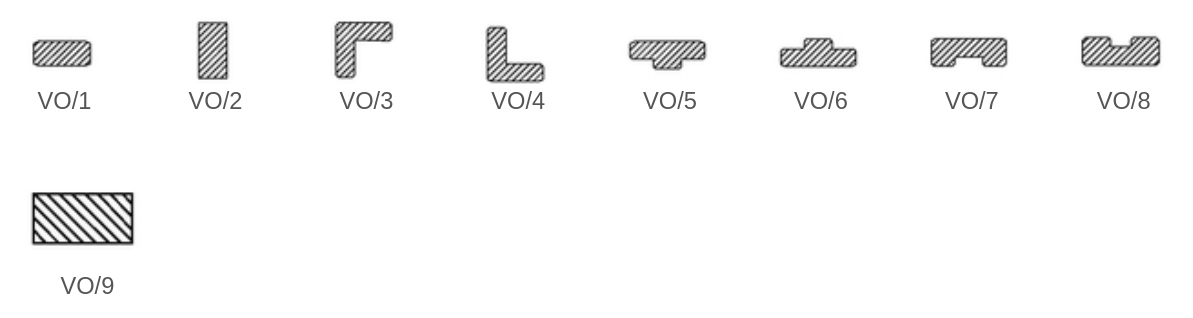
Guide rings play an important role in hydraulic and pneumatic cylinders, preventing radial forces from causing permanent damage to the cylinder and seal.
They are used for guiding piston rods and cylinders/pistons.

-
 Datasheet 1 - VO (pdf) 99 KB


Support rings are used together with O-rings or X-rings for static and dynamic loading.
Support rings prevent the sealing elements from being pushed out under high pressures, thus extending their service life. The support ring is always installed with the sealing element that is subjected to the pressure of the medium. In the case of pressures on both sides (e.g., a cylinder working bilaterally), support rings are installed on both sides of the seal.

-
 Datasheet 1 - OP (pdf) 95 KB

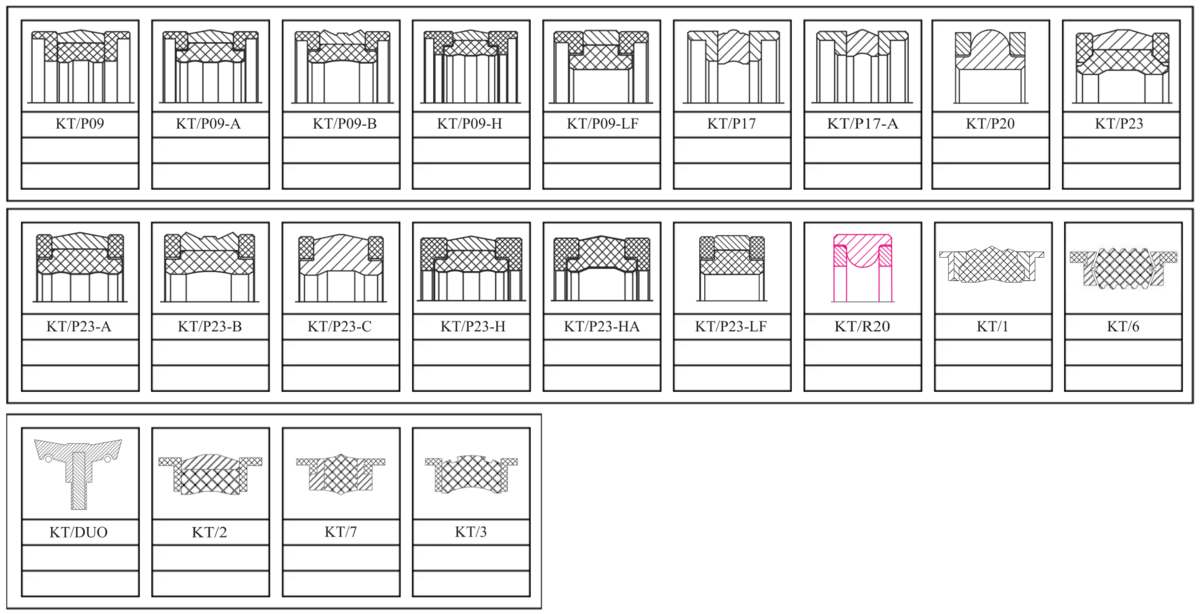
Combined seals are piston/cylinder seals that act bilaterally.
They combine a sealing element, two support rings to prevent dislodging, and two guiding elements.
These specialized sealing elements are designed to provide effective sealing and reduce friction, often incorporating multiple components (like sealing elements, support rings, and guide elements) to handle bilateral pressure and dynamic conditions.

- Sealing element (NBR, NBR + fabric, PU, FPM – Viton, …)
- Support rings (PU-TPU)
- Guide rings (POM)
The material of the sealing element should be selected considering the operating conditions (temperature, medium, ...).
Support and guide rings are cut for easier installation.
-
 Datasheet 1 - KT (pdf) 612 KB
-
 Datasheet 2 - KT (pdf) 180 KB

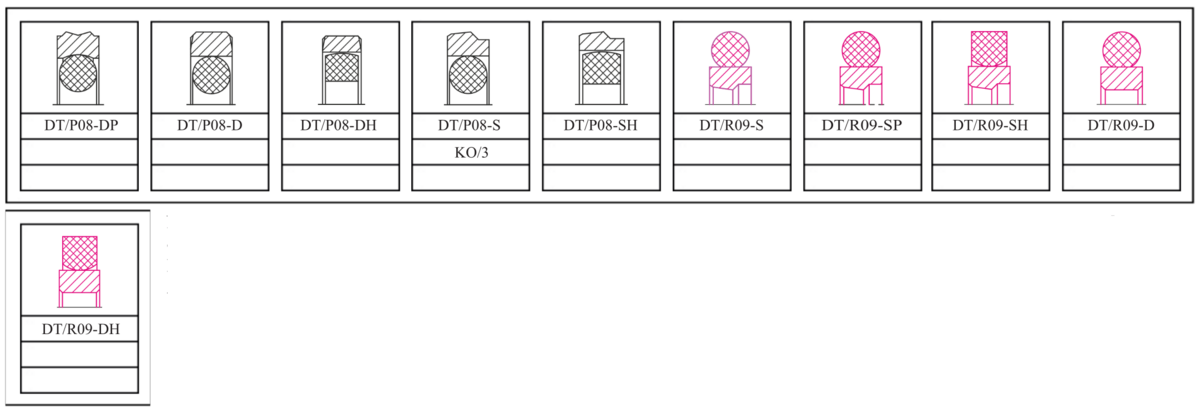
Sliding Seals: Reliability and Durability.
Advanced seals made of PTFE with elastic elements offer excellent friction resistance, making them ideal for dynamic, high-pressure applications.
The unfavorable behavior of O-rings, which causes friction and damage during dynamic operation, led to the development of sliding seals. Due to their excellent sliding properties, PTFE modified with carbon (graphite), bronze, or glass fibers is used to make these seals. Since PTFE is not as elastic as rubber materials, an elastic element, such as an O-ring or rectangular ring, is placed on the sliding ring to ensure proper sealing. This elastic element seals only static surfaces, preventing damage.
Most of these seals require minimal installation space and are suitable for snap-in installation. They are resistant to sudden loads and can handle high-pressure levels and linear speeds. Sliding seals are primarily manufactured as piston seals. In this case, the sliding ring has a smooth surface but can also be used for rod sealing. The surface of the sliding ring is designed to ensure a better grip. For improved sealing, two sliding seals are often installed.

- Sealing/sliding element (PTFE + graphite / glass fibers / bronze, PU)
- Elastic element (NBR, FPM - Viton)
-
 Datasheet 1 - DT (pdf) 567 KB
-
 Datasheet 2 - DT (pdf) 110 KB
